From a technology-strategy perspective, many companies look at four kinds of traces before they look at a company’s announcements or press coverage: patents, hiring, open source, and partnerships and physical resources (power and land). Each moves at a different speed, but all of them are important inputs for anticipating key markets and competitors.
First, a look at the speed of each:
· Patents — the last to arrive. Applications are usually published only 18 months after filing, so what you see now reflects decisions made a year and a half ago. Still, they show the overall direction of a strategy and where the weight is being placed.
· Hiring — the fastest to move. But the number of postings matters less than the ‘intent’ you can read from which roles are being filled, rather than how many people are being hired.
· Open source — like patents, it shows where a company is trying to go.
· Partnerships and physical resources — the binding force changes in stages: talk (rumours), money (investment), contracts, then breaking ground. Even for the same ‘announcement’, what matters is which stage it has reached, which is why many companies sense this themselves or through outside sources.
Applying these items to the leading AI companies in October gives the following picture.
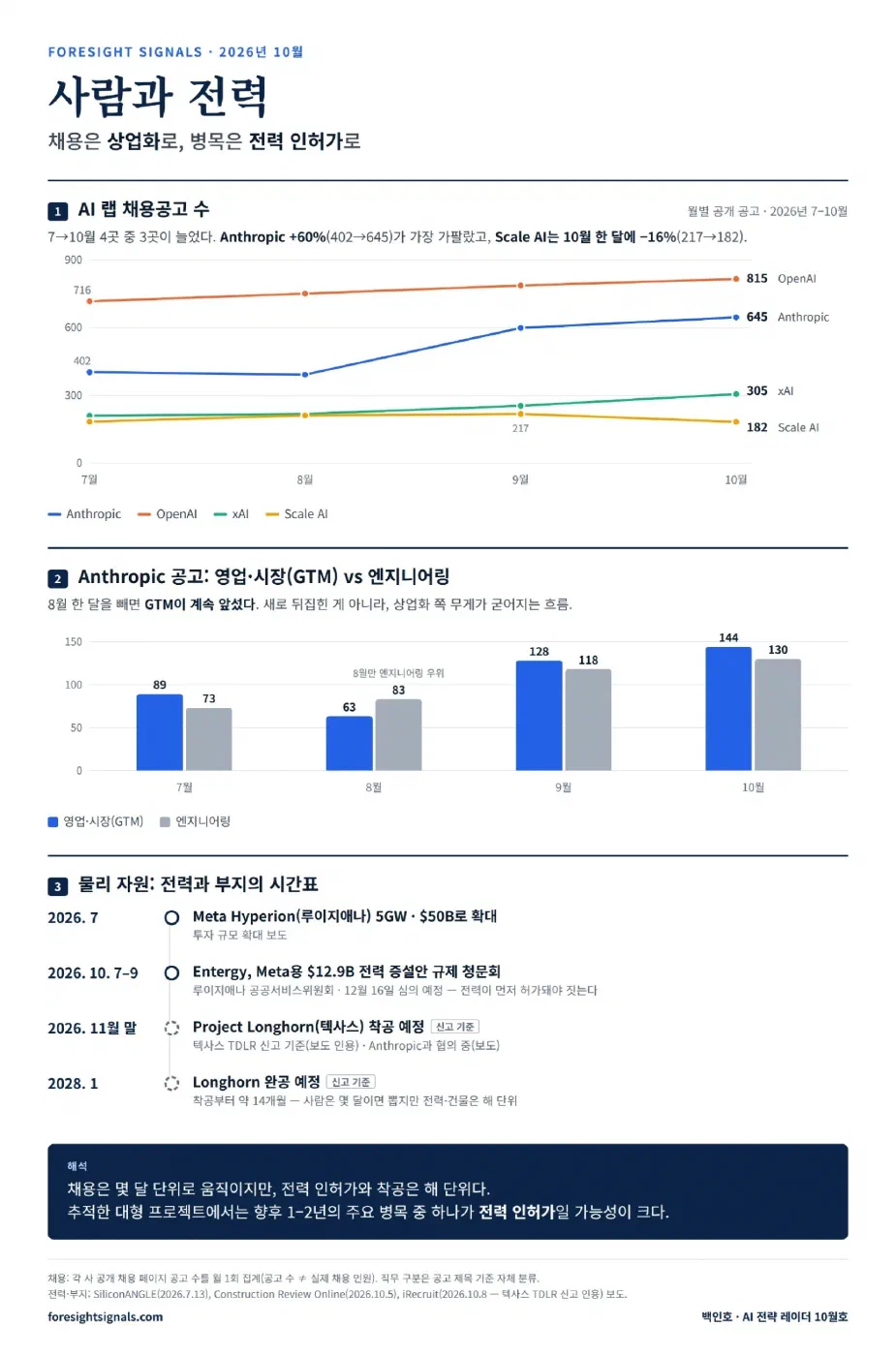
Hiring — the weight is shifting toward commercialisation. At Anthropic, sales and market postings outnumbered engineering postings in three of the four months from July to October (144 vs 130 in October). At OpenAI, the title “Applied AI Architect” first appeared in September and reached 24 postings in October. This role embeds the model into real work inside customer companies, and with GTM hiring also up, we can expect OpenAI to pursue more aggressive commercialisation ahead.
Open source — sign-in-with-chatgpt-devkit and mcp-extensions, which OpenAI released at the end of September, read as a move to extend ChatGPT into a sign-in and connection layer. Developer-friendly activity like this speeds up the growth of the ecosystem. It can be seen as an effort to build a pipeline through which outside resources feed the advancement of the company’s core assets.
Physical resources — power sets the schedule. Entergy’s proposed power expansion for a Meta data centre ($12.9 billion) went through hearings scheduled for October 7–9 and now awaits review by the Louisiana regulatory commission on December 16. Texas, meanwhile, has halted environmental permits for data centres since September 21. People can be hired in a few months, but power and construction move in years.
Patents — patent documents published from late August to early October numbered 696 for Apple, 27 for OpenAI and 1 for Anthropic. The gap is not a ranking of research capability; it reflects differences in company size and filing practice. A slow signal should be read as a slow signal, and over-interpreting it can lead to wrong judgements. In AI in particular, companies are moving toward a strategy of advancing and scaling quickly rather than protecting core technology through patents, so I don’t think patents can yet be treated as an important barometer. (Apple has a fair number of AI-related filings, but many of them apply AI to communications, such as modems and beam management.)
One more thing: while putting this together, I revised the agent that automatically collects these indicators several times. There was a collection error that showed zero patents, and some of what I had described as ’the trend reversed this month’ turned out to be trends that had been running for several months. The lesson was that accurately checking and interpreting signals that arrive sporadically or periodically matters more than I expected — as much as reading the indicators and the signals themselves.
Tables, sources and the corrections are on the site → https://foresightsignals.com/briefings/radar-2026-10/
#TechStrategy #AI #LeadingIndicators #Hiring #DataCenters #ForesightSignals