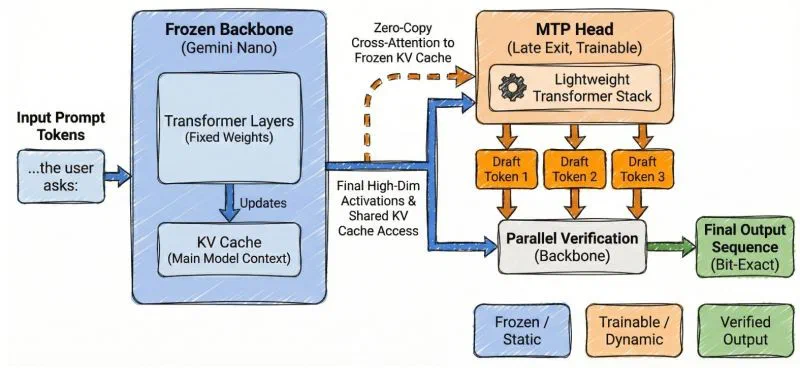
I took a shot at interpreting Google Research’s recently published ‘Frozen Multi-Token Prediction’ paper from my own perspective.
Google’s overall AI strategy looks like a ‘Two-Track’ approach, wielding cloud-centered giant models (Gemini Ultra/Pro) and personal-device-centered on-device models (Gemini Nano) as its two blades — and with the rollout of Gemma 4, that direction seems to be getting even more reinforced. This paper, in particular, reads as an effort to strengthen the on-device AI ecosystem.
In my view, there are three strategic reinforcement points Google is trying to achieve, and I think this paper is very much in line with them.
- Strengthening an ‘Apple-style ecosystem (lock-in)’ through hardware-software vertical integration
In the smartphone market, differentiating on hardware specs alone is now close to impossible. Google is the only company that owns its own chipset design (Tensor G5), its own Android OS, and its own AI model (Gemini Nano) all at once. The technical trick of using the chip’s idle compute capacity to boost local AI speed by up to 3x is hard for anyone but Google to pull off. It’s both a hardware sales pitch — “if you want the fastest local AI, buy a Pixel” — and the start of digging a technical moat that other smartphone makers can’t easily follow.
- Strengthening the ’economics and scalability’ of on-device agents (developer lock-in)
To become a platform holder in the AI ecosystem, you need a large number of outside developers on board. Until now, building an AI app for mobile devices meant re-optimizing for each device, or relying on expensive cloud servers. This time, Google used a ‘Frozen’ approach that doesn’t modify the main model, and it embedded this acceleration engine directly into Android developer tools (LiteRT-LM, Firebase SDK). That means outside developers can now build ultra-fast mobile AI apps on top of Google’s infrastructure without extra cost or a complicated training process. It’s a strong incentive pulling developers into Google’s on-device ecosystem.
- Maximizing ‘compute economics’ for real-time assistant services
AI going forward shouldn’t be a chatbot that only works when the user gives a command — it needs to become an ‘always-on agent’ that watches the screen in real time in the background, translates calls, and summarizes notifications. Here, battery life and heat are critical constraints. Combining a ‘Multi-Token Prediction (MTP)’ head to dramatically cut the number of computations builds the stamina for a smartphone to run an assistant AI in the background 24 hours a day without draining the battery or overheating. You could see this as strengthening the basic fitness needed to open a truly ‘real-time personalized agent’ era.
This might be only a small signal within a massive company’s broader strategy, or it might have nothing to do with it at all — but I looked at it through the lens I used to view Google back in my tech-strategy days. The more I look at it, the more impressive this company seems.
#Google #AIStrategy #OnDeviceAI #TechStrategy #VerticalStrategy #RnD
(Quoted — Google Research)
Today on the blog we introduce a method to retrofit Multi-Token Prediction onto frozen production models, accelerating on-device inference without the inefficiencies of separate drafters.Learn more →https://goo.gle/43XvmOo